Wednesday, May 29, 2013

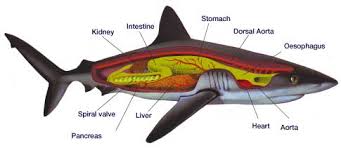
More about cartilaginous fish

1. Explain how cartilaginous and bony fish regulate the salt found in the water.
-Bony fish drink a lot of seawater to say hydrated. With cartilaginous fish, they are expected over the gills

2. What are some key difference in life history between cartilaginous fish and bony fish?
-Cartilaginous fish= slow reproducing
-bony fish= fast reproducers.

3. Describe how sharks reproduce. 
-Some sharks grasp the females pectoral fins, or bite and hold onto the body. 


What are cartilaginous fish

1. What makes cartilaginous fish different from other fish? Give examples.
-their Skeletons are made of cartilage.

2. List examples of cartilaginous fish.
-Skates


-rays
-shark.

3. What is special about the sharks eye?
-they have good vision in dim light. their pupil can dilate and contrast to control the incoming light.

4. What are the differences between bony fish and cartilaginous fish:
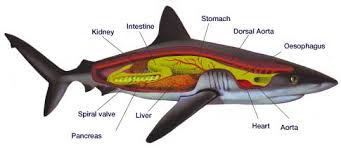
a. Heart and Blood - Sharks have fewer red blood cells,sharks have no bone marrow
b. External features - Shark skin is covered by dermal denticles. Bony fish are covered in flat scales.
c. Digesting and Evacuation - Bony fish have two seprate openings, sharks have only one opening called the cloaca.


Monday, May 27, 2013

Marine anthropods

1. What are examples of marine anthropods?
-northern lobsters, spiny lobsters, female rock crab, spotted cleaner shrimp.

2. What is the difference between an anthropod skeleton and a human skeleton?
-anthropods shed from their old one to a new one.

3. Compare/contrast how anthropods and humans move blood in their circulatory system.
-anthropdos are not like humans they don't have what we humansa have to pump blood like veins or arteries to carry the blood they pump loos through a sinvses.

4. How the eyes of anthropods differ from our eyes?
-they have compound eyes and easily detect movement.

5. How do humans use marine arthropods?
-we eat them.


Marine science words of wisdom

1. Choose a quote.
-grey whale mothers nurse their babies for 6-8 months giving them rich milk which allows them to quickly gain the blubber they will need in cold water. However, the mother barely eats during that time and loses 1/3 of her body weight. She is near exhaustion. By the time she and her calf begin their 10,000 mile migration to the bearing sea.
-life lesson from a grey whale your parents love you very much, want the best for you always, and will do just about anything to make sure you are successfully.


Nine major animal phyla

1.list all nine major animal phyla, and an example image of animal in the phlya.
*porifera                       *annelida
*colenterata                *arthropoda
*platyhelminthes      *mollusca
*nematod               *echinodermata
*chordata

2.what type of habitat can these species be found?
~Porifera-found in aquatic habitat.
~Colenetrata-found in marine habitat.
~platyhelminthes&nematoda-found in fresh and salt water terrestrial land.
~annelida, molluscs, and chordata- found in marine, fresh water, and terrestrial land.
~arthropoda-found in all enviroments.
~echinodermata-found in ocean floor.

3. How does the species digest food?
~platyhelmunthes&coelenterata have incomplete digestive system. (one opening)
~echinodermata, annelida, and nematoda have a complete digestive syatem. (two openings)

4. Have you seen an example of a species in phyla? Explain where and what Tue situation is.
~ no


End of the line movie part 2

BIG QUESTION: Why should we humans be concerned about our fishing?
1. What are the "big five" fish we eat?
-cod-haddock-tuna salmon & prwans.

2.what is the reason for not eating sharks or other low water fish?
- the reason is they have higher envirimental standards.

3. What are some fish to eat occasionaly and fish to avoid?
-TO EAT: crab, mussel, sword fish, anchovy. 
-NOT TO EAT: sea bass, shark, rays, marlin


Monday, May 13, 2013

End Of The Line Movie

BIG QUESTION: What happened to an ecosystem when a species goes extinct?

1. What is the most voracious predator in the ocean has ever seen?
-Humans

2. Are the oceans renewable? Why?
- yes if humans wern't fishing so much .

3. When did the cod become fished out, how many people lost their job?
- 1992, About 40 thousand people lost their job.

4. What puzzeled scientist in 2001, When was the answer found? And what was the answer?
- The world catch kept going up and up while local catch went down. The answer was found in china, China was catching a lot.


Energy Flows Through The Ecosystem

1. How does light and nutrients affect productivity in the oceans?
- They use solar energy to produce organic plan materials through photo synthesis.

2. What factors affect the ability of an ecosystem to support multiple trophic levels.
- Amount of energy
- Predators
- Energy Loss

3. Describe the process bioaccumulation an describe the DOT example.
- caused predators to lay thin egg shells.


Tuesday, April 23, 2013

Energy Flows Through The Ecosystem

1. A) As examples of primary producers are, and B) how do they get their energy
- They get their energy through solar energy  to produce organic plant materials through photosynthesis.

2. A) The second trophic level is made up of what creatures? B) From where do they get there energy?
- They get their energy through herbivores which feed souly on plants.

3. Why do predators make up the third trophic level?
- The predators feed at several trophic levels.


Animal Habitat Structure

1. How does eelgrass density influence abundance of species in an ecosystem?
- With more eelgrass the more animals and less eelgrass less animals. When the eelgrass is more dense the ecosystem becomes biodiverse.

2. Website to support thesis.
-  http://www.mass.gov/czm/coastlines/2004-2005/habitat/e_grass.htm
-  http://buzzardsbay.org/eelgrass.htm


Friday, April 19, 2013

Introduction into San Diego Bay

1. Sa diego is... (location, size, fact)
-San diego is located on the coast of the pacific ocean in southern california. With a population of 1,326,179 and is the 8th largest city in the united states

2. What type of activities occur on the bay?
-There is navy ships and ship ports

3. How and where on the bay is salt made?
-Salt is made through evaporation and on the edge of chula vista.

4. Where is the SD national wild life refuge complex located?
-In South San Diego in the largest mud flats.


Ocean Water And Climate Change

1. Which is more dense? Ocean water or fresh water?
- Ocean water. 2.5% more dense then fresh water. It is more dense due to the salt

2. How would global warming change water at the poles and the equator?
-At the poles the ice is going to melt and he equator will be affected by the increase of sea level.


Surface Water And Global Temperature

1. Thermal Inertia: San Francisco and NorFolk Virginia are on the same latitude. Why would NorFolk compared to San Francisco Have armer summers and cooler winers.
- San Francisco has air from the ocean while NorFolk has it from land

2. Describe the different ways temperature and moderate on earth . Without moderate temperature earth could not support life as we know it.
-Distance from ocean
-Water vapor
-Higher humidities = Moderate temperature 


Thermal Characteristics Of Water

1. Are heat and temperature same or different?
- They are different. Temperature is the measurement of kinetic energy. Heat is total energy

2. What is the heat capacity?
- The number of heat units needed to raise the temperature of a body by one degree.

3. How is the capacity of water unique?
- It is like a sponge. It is how much heat an object can absorb before it increases in temperature.

4. How does water temperature affect its density?
-The warmer the water the less dense. The cooler the denser.


Thursday, March 21, 2013

The Chemistry Of Water

1. Describe how water molecules are bonded.
- Water molecules are bonded by a covalent chemical bond

2. Describe how the positive and negative charges of water are distributed.
- Water is considered electrically neutral. the charges positive and negative are not distributed.

3. Describe the chemistry of water that allows an insect to walk on water.
- The surface of the water acts like a layer of elasticity when a small weight is placed upon it. This is called the surface tension of water.

4. What is unique about water and its density?
- When most liquids are formed into a solid the mass increase but when water is formed into ice the mass decreases which it allow it to float.


Tuesday, March 12, 2013

Sediment Core And History

1. Who is the author, and what is she researching?
- The author is Alyson Santoro and she is studying microbes in the nitrogen cycle.

2. What technique is the researcher using that is especially good at recovering delicate sediments?
- The technique is called multicoring.

3. What happens to the samples after it is loaded onto the ship?
- The scientist are on a mad dash to remove the cores from the frame and rushed into a special room called cold van.

4. What is the name of the research vessel?
- The name of the research vessel is called the melville.


Thursday, February 28, 2013

Four Types Of Marine Sediments


Julie/Ashley by julie-ferr on GoAnimate

Video Maker - Powered by GoAnimate.

The Economic Importance of Marine Sediments

1. What are some products that come from sediments?
-The materials for building roads and structures. Toothpaste, paint and swimming pool filters.

2. How much of the world's energy comes from sediments?
-1/3 of oil and gas come from the deposits of continental margins.

3. How important is sand and gravel?
-Sand and gravel are important because they value more than $510 million dollars.

-KEY QUESTIONS -
1. In what ways are sediments classified?
-Clastic, biochemical, or chemical precipitate.

2. List the types of marine sediments , Explain -
Lithogenous - they are formed by the weathering process. They are made up of small particles of rocks and oceanic volcanoes.

Biogenous - They are formed from the past life forms such as bones/teeth.
Hydrogenous - They are formed by minerals from the ocean's water by resulting into new minerals.

Hydrogenous - They are formed by precipitation of minerals from the ocean water.

Cosmogenous - They are formed by the nature surroundings and the sediments remains of large bodies of space materials such as comets and asteroids.


3. Where are sediments thickest? Are any areas of the ocean floor free of sediments?
-Continental slopes and rises is where sediments are thickest. There aren't any areas of the ocean floor free of sediments.


Island Arch and Ocean Trenches

Wednesday, February 13, 2013

Abyssal Plains


1. Define Abyssal Plains.
- It's an underwater plain on the deep ocean floor.

2. Describe where AP are found.
- They are found in depths of 3000 to 6000m in the Atlantic, as well as the Pacific.

3. Describe it's features.
- consist of volcanic rocks topped with sediments that are up to thousand of feet deep.

4. How much of the Earth do AP make up?
- They make up almost a third of Earth's surface.